निष्ठानन्द बज्राचार्य संग्रह नेपाल भाषा या लेखक, प्रकाशक व सुधारकया ज्यायात, पत्राचार व सम्पदाया डिजिटल छेँ जुगु।
थ्व संग्रह छेँय व समुदायया अभियानये दयेकाच्वंगु दु, स्रोत सामग्री जुर्नेत्, वर्गीकरण याइगु व अनुवाद यायेत्, वयकःगु ज्या न्ह्यूःमिपिनि लागि न्ह्यूयेगु, सिकयेगु व मुक्तये फैगु।
सार
In 1914, a year in which Newar, the language Kathmandu Valley Buddhists had for centuries spoken and preserved Newar literature in, was still banned from public usage, the priest and storyteller Niṣṭhānanda Vajrācārya did the unimaginable: he printed a 461-double-page version of the life of the Buddha which he had compiled from Sanskrit sources and translated into the spoken Newar of his day using print technology smuggled into the country from Calcutta, and distributed the book among his friends and relatives. Newar literary historians regard this as the beginning both of modern literary Newar and modern Newar literature.
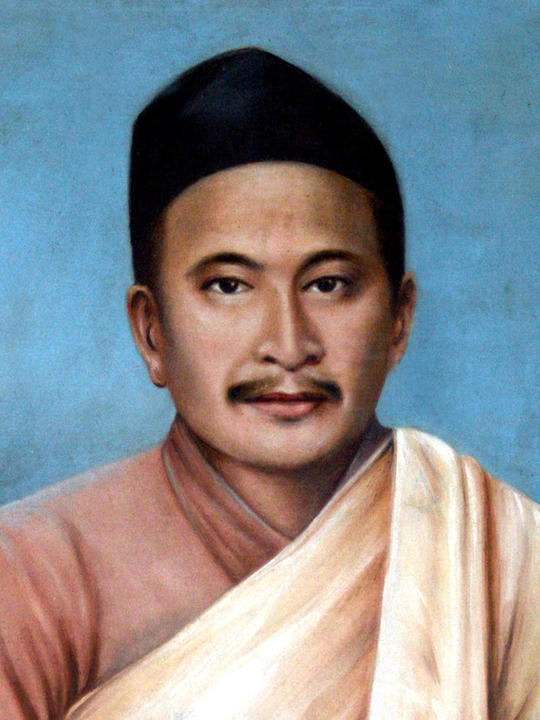
Buddhism, a Buddhist author, and a Buddhist text played a defining role in that historical moment. Niṣṭhānanda Vajrācārya (1858–1935) collated and assembled key Newar Sanskrit texts for a comprehensive hagiography of Buddha Śākyamuni, giving it a new hybrid literary-vernacular Newar form with nods to both his own Sanskrit and Nepali linguistic environments. He rooted it in the Kathmandu Valley on the cusp between the storytelling of his forefathers and the stirring linguistic and literary activists of the 20th century that would resist the suppression of the Newar language and prepare the ground for the resurgence of Newar literature from the spirit of Newar religiosity.
Prof. Christoph Emmrich · University of Toronto
Life & Work
Nisthananda Bajracharya (Nepali: निष्ठानन्द बज्राचार्य) (9 December 1858 – 29 November 1935) was a Nepalese writer who marked a turning point in Nepal Bhasa literature by breaking away from the classical style and writing prose in colloquial language. He was one of the leaders of the Nepal Bhasa renaissance, and a pioneer of printing with moveable type in Nepal. He is honored as one of the Four Pillars of Nepal Bhasa.
Early Life
Bajracharya was born in Om Bahal, Kathmandu to father Muktananda and mother Thakumati Bajracharya. He belonged to a family of hereditary Newari Buddhist priests who engaged in performing sacred rituals. His first wife Ratna Prabha died in 1901, and he subsequently married Dyah Mayju.
Career
In 1901, after completing Buddhist studies, Bajracharya began giving religious discourses. His storytelling sessions were held in sacred courtyards and other open spaces and lasted four months. Bajracharya had a clear style of narrating stories which made him greatly popular. He adapted the ancient texts into easy-to-understand everyday language, as the old writing style had become complex to listeners.
The written and spoken forms of Nepal Bhasa had begun to grow apart as its development came to an end around 1850 with the advent of the Rana dynasty. The Ranas did not like Nepal Bhasa and suppressed its use. By the time literary activities were revived during the Nepal Bhasa renaissance, the old style of writing had become difficult to follow. Bajracharya modernized the language by discarding traditional spelling rules and writing it as it was spoken. He also brought a new style into prose writing by simplifying sentence construction.
Publications
In 1909, Bajracharya published Ek Bishanti Prajnaparamita, the first book in Nepal Bhasa to be printed with moveable type. Lalita Vistara, his most famous work — based on the Buddha's life story — and Swayambhu Purana were published in 1914. Bajracharya travelled to Kolkata, India to procure letterpress type as printing facilities were not available in Kathmandu. He did the typesetting and printing himself. Lalita Vistara also contributed to the revival of Buddhism in the 1920s.
Legacy
A bust of Bajracharya was erected at his birthplace Om Bahal, Kathmandu on 23 November 1998 by Olympus Club (Nisthananda Memorial Trust). A street in central Kathmandu was named Nisthananda Marg in his honor by Kathmandu Metropolitan City.
पूरा वेबसाइट भरसक वइगु